-
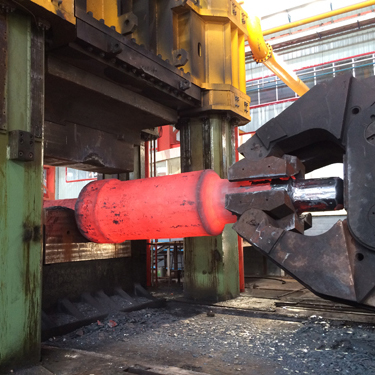
Forged: The forging process (hammering, pressing) compresses and elongates the metal's internal grains. It also refines them, making them smaller and tighter. Most importantly, the grain flow is continuous and follows the contour of the part's shape. This is like the grain in a piece of strong, tough wood.
-
Non-Forged (Cast): The metal is poured as a liquid into a mold. As it solidifies, the grains form randomly and are typically larger and coarser. The grain flow does not follow the part's shape. This can lead to pockets of weakness, like voids or porosity, from shrinkage during cooling.
-
Non-Forged (Machined from Bar): The grain structure is whatever was created when the original metal bar was made (usually by rolling or extrusion). The grains are uniform but not aligned to the part's shape. Machining can even cut through the grain flow, potentially exposing endpoints for cracks to start.
When to Choose Which?
Choose FORGING for:
-
Critical safety components where failure is not an option (e.g., aircraft parts, automotive suspension).
-
Applications with high impact, shock loading, or constant stress cycles (fatigue).
-
Parts that need to be strong but also lightweight (the strength allows for less material to be used).
-
High-volume production where the upfront tooling cost can be justified.
Choose CASTING for:
-
Extremely complex shapes with internal passages (e.g., water jackets in an engine block).
-
Very large parts that would be impossible or prohibitively expensive to forge.
-
Decorative items where intricate detail is required (e.g., fences, statues).
-
Applications where ultimate strength is less critical than cost and shape complexity.
Choose MACHINING from Bar for:
-
Low-volume production or prototypes where custom tooling for forging/casting is too expensive.
-
Extremely high precision and tight tolerances are required.
-
Parts that are simple and don't warrant the cost of creating a mold or die.
-
Unique or custom one-off parts.
Summary Analogy
-
Forging is like kneading dough. You work it, align the gluten (grains), and make it strong and uniform.
-
Casting is like making a Jell-O mold. You pour it in and it takes the shape, but the internal structure is random and can have bubbles (defects).
-
Machining is like whittling a stick. You start with a blank and carve away everything that doesn't look like your part, but you're at the mercy of the original stick's quality.
In short: Forging is chosen for superior strength and reliability in high-stress applications, while non-forged methods (casting, machining) are chosen for complexity, large size, design flexibility, or cost-effectiveness in lower-stress scenarios.