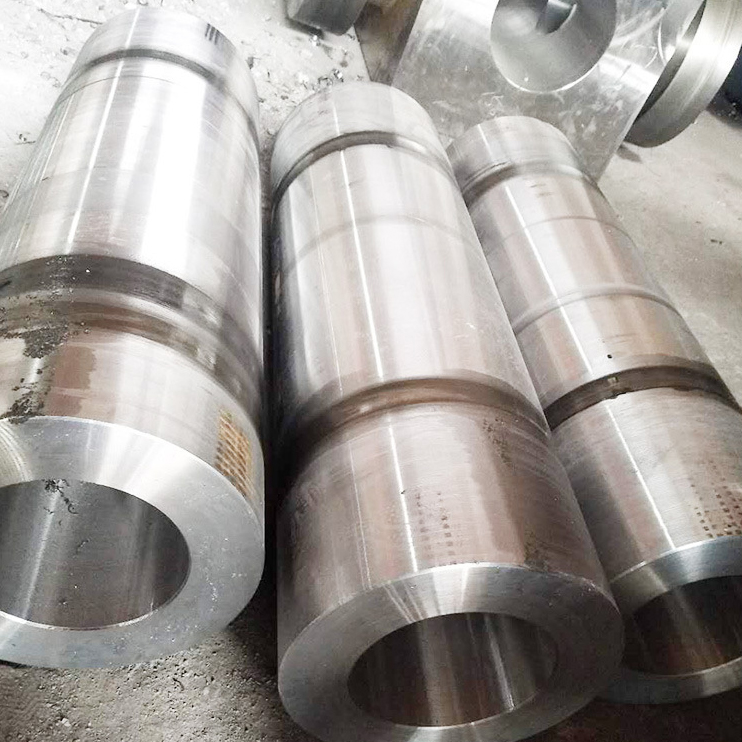
A forged pipe (more accurately called a forged and bored pipe) is a hollow, cylindrical component designed to convey fluids, gases, or other materials under high pressure, temperature, or stress. It is created by forging a solid billet of metal and then drilling (boring) a hole through its center. This process prioritizes superior mechanical strength and structural integrity over ease of manufacturing. The key idea is that the pipe's wall is formed from the solid, compressed core of the original metal billet, not from a rolled and welded plate or a continuously cast hollow.
How It's Made: The Forging and Boring Process
The manufacturing process is significantly different from that of seamless rolled pipe and is key to its properties:
-
Billet Selection: A solid cylindrical billet of high-quality alloy steel (e.g., stainless steel, chrome-moly) is cut to a specific size.
-
Heating: The billet is heated in a furnace to a high temperature where the metal becomes plastic and malleable.
-
Forging: The red-hot billet is placed under immense pressure in a hydraulic forge press. It is worked, often using open-die forging techniques, to form a rough cylindrical shape. This step compacts the metal, eliminates voids, and refines the grain structure.
-
Piercing and Boring: The solid forged cylinder is not hollow yet. It is moved to a horizontal boring mill where a large drill bit precisely machines a hole through the entire length of its center.
-
Heat Treatment: The rough pipe undergoes heat treatment (normalizing, quenching, and tempering) to achieve the desired mechanical properties like specific tensile strength, hardness, and toughness.
-
Finishing: The pipe is finish-machined to its final dimensions (Outside Diameter and Wall Thickness) on a lathe. It may also be honed or polished on the inner diameter (ID) for a smooth surface finish.
Key Advantages of Forged Pipe
The forging process gives these pipes unique advantages for critical applications:
-
Exceptional Strength and Structural Integrity: This is the primary advantage. The forging process creates a continuous, uniform grain flow that follows the shape of the pipe. There are no seams, welds, or laminations, which are potential points of failure.
-
Superior Safety under High Pressure: Because there is no weld seam, forged pipes can handle extremely high internal pressures without risk of a seam rupture. They are ideal for high-pressure applications.
-
Homogeneous Material Properties: The wall thickness has consistent mechanical properties throughout, with no variation between a base metal and a weld zone.
-
Excellent Impact and Fatigue Resistance: The refined grain structure makes them highly resistant to shock loads, pressure cycles, and vibrations that could cause fatigue cracks in weaker pipes.
-
Better for Thick Walls: The forging and boring process is exceptionally well-suited for manufacturing pipes with very thick walls, which are necessary for ultra-high-pressure services.
Disadvantages
-
Extremely High Cost: The process is labor, energy, and time-intensive, making forged pipe significantly more expensive than seamless or welded pipe.
-
Size Limitations: There are practical limits to the length and diameter that can be economically forged and bored. They are generally not produced in the long continuous lengths that seamless pipes are.
-
Longer Lead Times: The complex manufacturing process results in much longer production and delivery times.
Common Applications
Forged pipes are used in extreme service conditions where failure is catastrophic and cost is a secondary concern. You will find them in:
-
Power Generation: Main steam lines and feedwater lines in high-pressure fossil fuel and nuclear power plants.
-
Oil & Gas: High-pressure manifold systems, choke and kill lines on drilling rigs, and components in subsea production trees.
-
Petrochemical: High-pressure reactor feed lines, outlet headers, and process piping in hydrocrackers and reformer units.
-
Hydraulic Systems: Manifolds and lines for ultra-high-pressure hydraulic systems (e.g., in heavy machinery, presses).
-
Aerospace and Defense: Hydraulic lines and fuel systems in aircraft and spacecraft where reliability is paramount.