

This process aligns the metal's grain structure (the microscopic fiber-like lines within the metal) to flow continuously throughout the ring's circumference. This is the key to its superior strength.
How is a Forged Ring Made? (The Process Step-by-Step)
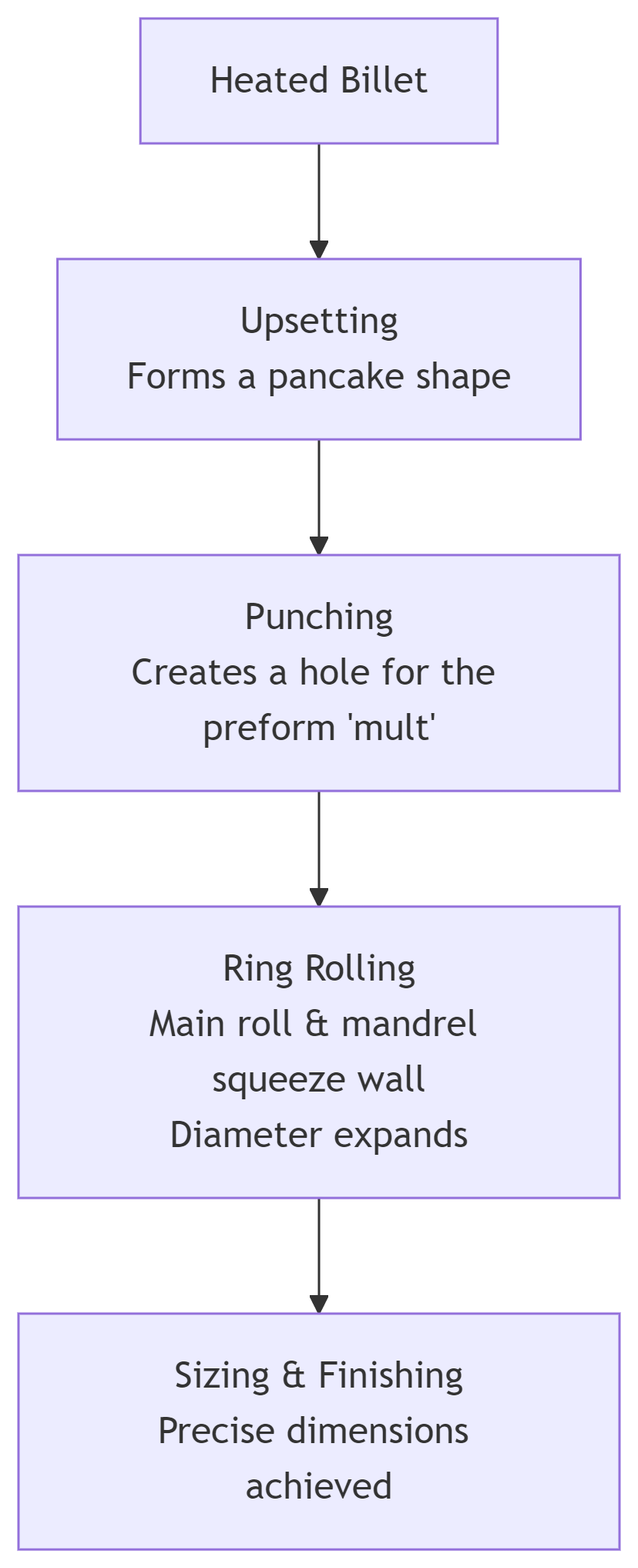
The most common method is called Ring Rolling. Here’s how it works:
-
Starting Material: The process begins with a single piece of metal (billet) that is heated to a high temperature (typically over 2,100°F / 1,150°C for steel) to make it malleable.
-
Upsetting & Punching:
-
The heated billet is placed under a press and "upset" (compressed) to form a thick, pancake-like shape.
-
A powerful press then punches a hole directly through the center of this pancake, creating a rough donut shape called a "mult" or preform.
-
-
Ring Rolling:
-
The hot mult is placed over an idler or mandrel roll.
-
A main drive roll moves towards the mult, applying tremendous pressure and squeezing the wall between them.
-
As the rolls rotate, the metal is stretched and the wall becomes thinner, causing the ring's diameter to expand.
-
During this process, axial (side) rolls can also be used to control the height and width of the ring.
-
-
Sizing & Finishing: The rolling continues until the ring reaches its precise predetermined dimensions. It is then cooled and undergoes various finishing processes like machining, heat treatment, and testing.
This animation illustrates the ring rolling process perfectly:
Key Advantages and Characteristics
Forged rings are specified for critical applications because of their exceptional properties:
-
Superior Strength & Structural Integrity: The forging process refines the metal's grain structure, making it dense and continuous around the circumference. This eliminates weaknesses like porosity, shrinkage, and gas pockets found in castings.
-
Seamless Construction: Because it is formed from a single piece of metal, there are no welds. This eliminates a potential point of failure from weld defects, especially under high stress, pressure, or cyclic loading.
-
Material and Cost Efficiency: Ring rolling allows for the creation of large diameters with a relatively small amount of material, minimizing waste compared to machining a ring from a solid plate.
-
Directional Strength: The grain flow is oriented to provide maximum strength in the direction of highest stress—around the circumference. This is ideal for parts that rotate or contain pressure.
-
Ability to Make Large Parts: This process can produce rings of enormous size (over 10 meters/30 feet in diameter) that would be impossible or impractical to cast or machine from a solid piece.
Common Applications
You will find forged rings in some of the most demanding industrial sectors:
-
Aerospace: Engine casings, turbine mounts, and rotating components in jet engines.
-
Wind Energy: The critical bearing rings that connect the nacelle (the main housing) to the tower, allowing the turbine to rotate and face the wind.
-
Oil & Gas: Flanges, wellhead equipment, and components for subsea pipelines that must withstand extreme pressures and corrosive environments.
-
Heavy Machinery: Gears, rollers for mining equipment, and large bearings for construction cranes.
-
Nuclear Power: Pressure vessel supports and other critical structural components within a reactor.
-
Space & Defense: Rocket body sections, launch vehicle components, and missile rings.
In short, a forged ring is a high-strength, seamless, circular metal component whose manufacturing process is tailored to provide unmatched reliability for the most critical applications in modern engineering.