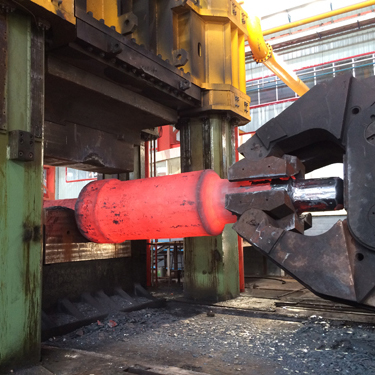
What is a Forging Process?
In simple terms, forging is a manufacturing process where metal is shaped by applying compressive force, typically through the use of a hammer, press, or die. Unlike casting, where metal is melted and poured into a mold, forging works with solid metal that is often, but not always, heated to make it more malleable.
The core principle of forging is that it refines the metal's internal grain structure. The application of force breaks up impurities, closes empty spaces (porosity), and aligns the grain flow to follow the general shape of the part. This results in a finished product that is exceptionally strong, tough, and reliable.
The Fundamental Steps of the Forging Process
While specific techniques vary, most forging operations follow these general steps:
1. Preparing the Stock: The process begins with a piece of metal called a "stock" or "billet," which is usually a bar or ingot cut to a specific volume.
2. Heating (for hot/warm forging): The billet is heated in a forge or furnace to a specific temperature where it becomes ductile ("plastic") but remains solid. This temperature varies by metal (e.g., steel is often heated to around 2,200°F / 1,200°C).
3. Forming: The heated, malleable billet is placed on a die or anvil. immense compressive force is applied:
* Hammers deliver impact blows to deform the metal.
* Presses apply a gradual, squeezing pressure to shape the metal.
4. Finishing (Secondary Operations): The forged part, now called a "forging," may undergo various secondary processes such as:
* Trimming: Excess metal (flash) is cut off.
* Heat Treating: The part is reheated and cooled under controlled conditions to achieve desired properties like increased hardness or strength.
* Machining: Precise dimensions and finishes are achieved by grinding or milling.
* Surface Treatment: Processes like shot blasting or painting are applied for corrosion resistance and appearance.
Key Types of Forging Processes
Forging is categorized based on the temperature of the metal and the type of equipment used.
1. By Temperature
Hot Forging: The most common type. Metal is heated above its recrystallization temperature. This prevents strain hardening, allows for significant shape change, and requires less force. It produces parts with superior strength and is ideal for high-volume production.
Cold Forging: Metal is shaped at or near room temperature. This process increases the metal's strength through strain hardening (also called work hardening) and offers excellent surface finish and dimensional accuracy. However, it requires more powerful equipment and is limited in how much the metal can be deformed. Examples include nails, bolts, and rivets.
Warm Forging: Conducted below the recrystallization temperature but above room temperature. It offers a balance between the advantages of hot and cold forging, providing better precision than hot forging and requiring less force than cold forging.
2. By Equipment/Technique
Open-Die Forging (Free Forging): The workpiece is compressed between two flat or simple-shaped dies that do not enclose the metal. The operator must reposition the workpiece to achieve the desired form. It is used for large, simple shapes like shafts, rings, and cylinders.
Closed-Die Forging (Impression-Die Forging): The heated billet is placed in a pair of dies that contain a precut impression of the desired part shape. The dies are brought together, forcing the metal to fill the cavities. This is how complex, high-precision parts like connecting rods and wrenches are made. Excess metal forms "flash" which is later trimmed off.
Roll Forging: A round or flat bar is passed through two specially shaped rolls that gradually reduce its cross-section and increase its length to form a part like a leaf spring or an axe handle.
Common Applications of Forged Parts
Forged components are critical in industries where failure is not an option:
Automotive: Crankshafts, connecting rods, gears, axles
Aerospace: Jet engine turbines, landing gear components, structural parts
Industrial: Giant shafts for turbines, gears, valves, and high-pressure fittings
Tools: Wrenches, hammers, pliers, and surgical instruments
Military & Defense: Components for firearms, tanks, and missiles
In summary, forging is a foundational metalworking process that transforms a simple piece of metal into a high-strength, high-integrity component by strategically applying force to improve its very internal structure. It is the process of choice for making the world's most critical and heavily loaded metal parts.