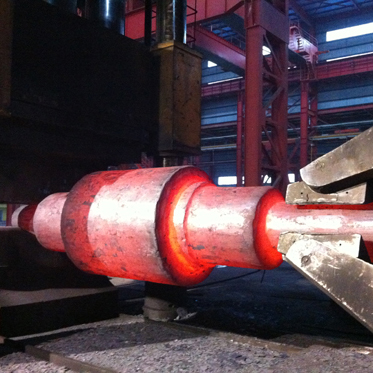
What are the 4 types of forging?
The four primary types of forging are categorized based on the technique and equipment used to apply the compressive force. They are:
1. Open-Die Forging
2. Closed-Die Forging
3. Roll Forging
4. Cold Forging
Here is a detailed breakdown of each type:
1. Open-Die Forging (Free Forging)
Process: The workpiece is compressed between two flat or simple-shaped dies that do not enclose the metal. The operator must continuously position and manipulate the workpiece (through hammering or pressing) to achieve the desired shape through a series of deformations.
Key Characteristics:
Dies are simple: Typically flat, concave, or V-shaped.
Skill-dependent: Requires a highly skilled operator to maneuver the metal.
Not net-shape: The final part requires significant secondary machining to achieve precise dimensions.
Common Applications: Large, simple shapes like shafts, discs, cylinders, rings, and rough pre-forms for more complex closed-die forging.
2. Closed-Die Forging (Impression-Die Forging)
Process: The heated metal billet is placed in a lower die that contains a pre-cut impression of the desired part shape. A matching upper die is forced down, causing the metal to flow and completely fill the die cavities. Excess metal squeezes out around the perimeter as flash, which is later trimmed off.
Key Characteristics:
Complex shapes: Can produce highly complex and intricate parts with excellent detail.
Net-shape/Near-net-shape: Parts require very little final machining.
High precision: Excellent dimensional accuracy and repeatability.
Higher initial cost: Dies are complex and expensive to manufacture.
Common Applications: High-strength critical components like connecting rods, crankshafts, gears, and tools (wrenches, pliers).
3. Roll Forging
Process: A round or flat bar stock is passed between two powered rolls that contain matching grooves. These grooves progressively reduce the stock's cross-section and increase its length, forming the part. The stock is fed back and forth through the rolls until the final shape is achieved.
Key Characteristics:
Elongation: Primarily used to reduce thickness and extend the length of a workpiece.
Pre-formed shapes: Often used to create tapered sections (like leaf springs or axe handles) before they go through another forging process.
Efficient: Good for producing long parts with consistent cross-sections.
Common Applications: Leaf springs, knives, axe handles, and pre-formed blanks for other forging operations.
4. Cold Forging
Process: This is not defined by a specific machine, but by the temperature of the metal. Cold forging encompasses many techniques (like bending, extruding, and heading) performed at or near room temperature.
Key Characteristics:
Strain hardening: The process increases the strength and hardness of the metal through mechanical work.
Excellent finish: Provides a superior surface finish and tight dimensional tolerances.
High efficiency: No heating costs, and material waste is minimized.
Requires more force: Shaping cold metal requires significantly more force than hot forging.
Common Applications: Everyday items like nails, screws, bolts, rivets, and other fasteners.
Important Note: These types are often used in combination. For example, a part might start as an open-die pre-form before being finished in a closed-die press to achieve its final, complex shape efficiently.